
Measure your insert, then choose a cover that is the same size or about 1–2 inches smaller. A same-size cover gives a relaxed, softer look. A cover 1–2 inches smaller than the insert makes the pillow look fuller, plumper and more tailored. For example, a 20 × 20 insert fits a 20 × 20 cover for a soft look, or an 18 × 18 cover for a fuller look.
Measure your insert
Same size = soft, relaxed
1–2 in smaller = full, plump
The quick answer
Match your pillow cover to the finished size you want. Use the same-size insert for a softer look, or choose an insert 1–2 inches larger for a fuller, plumper finish.
These are starting points, not rules.
For decorative pillows, common square sizes include 12 × 12, 14 × 14, 16 × 16, 18 × 18, 20 × 20, 22 × 22, 24 × 24 and 26 × 26. Rectangular and lumbar sizes include 12 × 16, 12 × 20, 12 × 24, 12 × 30, 14 × 20 and 14 × 36.
Find Your Size in 30 Seconds
Start with where the pillow will live. Use these quick starting points, then adjust for the scale of your furniture and the amount of fullness you prefer.
Swipe to see all sizes →
| Cover size | Soft / relaxed insert | Fuller / plumper insert |
|---|---|---|
| 12 × 12 | 12 × 12 insert | 14 × 14 insert |
| 14 × 14 | 14 × 14 insert | 16 × 16 insert |
| 16 × 16 | 16 × 16 insert | 18 × 18 insert |
| 18 × 18 | 18 × 18 insert | 20 × 20 insert |
| 20 × 20 | 20 × 20 insert | 22 × 22 insert |
| 22 × 22 | 22 × 22 insert | 24 × 24 insert |
| 24 × 24 | 24 × 24 insert | 26 × 26 insert |
Small sofa or loveseat
16 × 16 or 18 × 18
Two squares, optionally with one small lumbar.
Standard sofa
18 × 18 or 20 × 20
Two to four squares plus a lumbar for contrast.
Large or deep sofa
22 × 22 or 24 × 24
Layer larger back pillows with smaller fronts.
Accent chair
16 × 16 or 12 × 20 lumbar
Keep the pillow proportional to the chair back.
Bench or daybed
20 × 20, 22 × 22 or lumbar
Use a repeated rhythm rather than crowded layers.
Relaxed and soft
choose a same-size insert for a gentle, less structured shape.
Full and tailored
choose an insert that is 1–2 inches larger than the cover.
Layered
start with larger squares at the back and add smaller squares or a lumbar in front.
Minimal
use fewer pillows with clear, consistent proportions.
Pillow Cover vs Insert Size: How Do They Relate?
A pillow cover is the removable textile shell. An insert is the filled cushion that sits inside it. The two work together: the cover determines the finished dimensions and surface style, while the insert determines the shape, support and fullness.
Cover anatomy
seam
zipperinsert
Seam-to-seam labeled size.
Fill, firmness and preference
The 1–2 inch guideline
For a fuller pillow, choose an insert that is usually 1–2 inches larger than the pillow cover. For a softer, more relaxed finish, use an insert in the same size as the cover.
Worked example: 20 × 20
For a 20 × 20 pillow cover, use a 20 × 20 insert when you want a softer and more relaxed appearance. Use a 22 × 22 insert when you want a fuller, plumper appearance, provided the insert fill and cover fabric can accommodate it comfortably.
Soft & relaxed
Full & plump
Too tight
How to measure a pillow cover
- Lay the empty pillow cover flat.
- Measure seam to seam across the width.
- Measure seam to seam across the height.
- Use the finished measurement—not the fabric edge or piping—as your cover size.

Rohiyaan offers eight square sizes (12 × 12 to 26 × 26) and six rectangular lumbar sizes (12 × 20 to 14 × 36). The chart shows typical uses for each. “Offered” means the size is in the Rohiyaan range; individual styles may come in fewer sizes, so check the product page. Bhujodi covers are currently offered in 18 × 18, 20 × 20 and 22 × 22 only.
Swipe to see all sizes →
Bhujodi20 × 20
Bhujodi22 × 22
Bhujodi24 × 2426 × 26 A4
| Pillow cover size (in) | Shape | Typical decorating use | Suitable room / location | Insert relationship (full look) | Visual effect | Rohiyaan availability |
|---|---|---|---|---|---|---|
| 12 × 12 | Square | Small accent | Chair, nursery, layered sofa | Same size relaxed; +2 fuller | Compact detail | Check current collection |
| 14 × 14 | Square | Small accent | Chair, small bench, layering | Same size relaxed; +2 fuller | Neat and light | Check current collection |
| 16 × 16 | Square | Everyday accent | Chair, loveseat, bed layer | Same size relaxed; +2 fuller | Balanced small scale | Check current collection |
| 18 × 18 | Square | Classic sofa size | Sofa, chair, bed | Same size relaxed; +2 fuller | Versatile and familiar | Check current collection |
| 20 × 20 | Square | Generous everyday layer | Sofa, bed, daybed | Same size relaxed; +2 fuller | Comfortable presence | Check current collection |
| 22 × 22 | Square | Large decorative pillow | Deep sofa, queen or king bed | Same size relaxed; +2 fuller | Plush and substantial | Check current collection |
| 24 × 24 | Square | Oversized layer | Deep sofa, king bed, floor setting | Same size relaxed; +2 fuller | Relaxed luxury | Check current collection |
| 26 × 26 | Square | Statement back layer | Large bed, extra-deep sofa | Same size relaxed; +2 fuller | Architectural scale | Check current collection |
| 12 × 16 | Rectangle | Small lumbar accent | Chair, bench, layered bed | Match or size up gently | Light horizontal line | Check current collection |
| 12 × 20 | Lumbar | Classic lumbar | Chair, sofa, bed front | Match or size up gently | Grounding centre accent | Check current collection |
| 12 × 24 | Lumbar | Long lumbar | Sofa, queen bed, bench | Match or size up gently | Elongated and tailored | Check current collection |
| 12 × 30 | Lumbar | Wide lumbar | Daybed, queen or king bed | Match or size up gently | Broad horizontal anchor | Check current collection |
| 14 × 20 | Lumbar | Fuller lumbar | Chair, sofa, bed | Match or size up gently | Soft but structured | Check current collection |
| 14 × 36 | Long lumbar | Statement lumbar | King bed, bench, large sofa | Match or size up gently | Strong focal line | Check current collection |
International note: 1 inch equals 2.54 centimetres. To convert a pillow cover measurement from inches to centimetres, multiply each side by 2.54.
Pillow Cover Sizes Explained, One by One
12 × 12
A small square for compact chairs, small-scale layering and decorative detail.
Same size relaxed; +2 fuller14 × 14
A neat accent size for a chair, bench or smaller sofa arrangement.
Same size relaxed; +2 fuller16 × 16
A flexible small-to-medium square that works on accent chairs, loveseats and beds.
Same size relaxed; +2 fuller18 × 18
A classic decorative pillow size that suits most sofas and works well as a bed layer.
Also available in Bhujodi20 × 20
A generous square with comfortable visual weight for sofas, daybeds and beds.
Also available in Bhujodi22 × 22
A larger pillow for deeper seating and more substantial bed styling.
Also available in Bhujodi24 × 24
An oversized square that creates a relaxed, plush foundation on large furniture.
Same size relaxed; +2 fuller26 × 26
A statement square best used as a back layer where there is enough depth and width.
Same size relaxed; +2 fuller12 × 16
A petite rectangular pillow that adds a horizontal accent without taking over the arrangement.
Match or size up gently12 × 20
A classic lumbar proportion for a chair, sofa or the front of a bed arrangement.
Match or size up gently12 × 24
A longer lumbar for sofas, benches and queen beds where a wider line is useful.
Match or size up gently12 × 30
A broad lumbar that can visually connect a daybed, bench or larger bed arrangement.
Match or size up gently14 × 20
A fuller lumbar that offers more height than a 12-inch lumbar while retaining a horizontal shape.
Match or size up gently14 × 36
A long statement lumbar for king beds, benches and large sofas.
Match or size up gentlySquare or Rectangular Pillows: Which Should You Choose?
Square
softness
Square pillows are versatile and create an easy, layered foundation. They are especially useful on sofas and beds because several sizes can be stacked from large to small.
Lumbar
Rectangular pillows, often called lumbar pillows, add a horizontal line. Use them to break up a group of squares, centre a bed arrangement, support the lower back in a chair, or create a tailored finish on a bench.
How does pillow size change the look of a room?
Small pillows can feel light and detailed. Larger pillows can make a room feel softer and more grounded. The most successful scale is usually relative to the furniture: a small chair benefits from a smaller pillow, while a deep sofa or wide bed can carry larger sizes without looking crowded.
What Size Pillows Should You Use on a Bed?
Decorative pillows should support the proportions of the bed rather than hide it. Start with sleeping pillows and shams, then add decorative squares and a lumbar only when they suit the bed width and headboard scale.
Layer a bed from back to front
Mattress-width reference: twin 38 in. · full 54 in. · queen 60 in. · king 76 in.
| Bed type | Useful decorative sizes | Arrangement direction |
|---|---|---|
| Twin | 16 × 16, 18 × 18, 12 × 20 lumbar | Keep the arrangement simple and centred. |
| Full | 18 × 18, 20 × 20, 12 × 24 lumbar | Use one or two decorative layers. |
| Queen | 20 × 20, 22 × 22, 12 × 30 lumbar | Layer squares behind one centred lumbar. |
| King | 22 × 22, 24 × 24, 14 × 36 lumbar | Use larger squares to hold the bed’s width. |
| Daybed | 20 × 20, 22 × 22 and lumbar sizes | Use a repeated back row with a long front accent. |
| Bench | 12 × 20 to 14 × 36 lumbar | Choose one long lumbar or a balanced group of smaller pillows. |
A useful reference is the mattress width: wider mattresses generally need wider or more numerous decorative pillows. Headboard height matters too. A tall or visually substantial headboard can support larger squares, while a low headboard usually looks better with lower, simpler layers.


What Size Pillow Covers Look Good on a Sofa or Chair?
Measure-first sofa guide
Small sofa or loveseat
Use two 16 × 16 or 18 × 18 pillows. Add a small lumbar only if the seat is wide enough.
Standard sofa
Start with 18 × 18 or 20 × 20 squares. Combine sizes for depth, or add a lumbar at the centre.
Large or deep sofa
Use 22 × 22 or 24 × 24 pillows at the back so the arrangement does not disappear into the depth of the seat.
Sectional
Repeat a limited family of sizes across the corners and long sections, varying colour or pattern rather than introducing too many shapes.
Accent chair
Use one 16 × 16 square or one 12 × 20 lumbar. The pillow should not cover the chair’s entire back.
Reading chair or armchair
A lumbar can add practical lower-back support while keeping the chair visually open.


Should all your pillows be the same size?
No. Using all the same size can look calm, symmetrical and intentional—especially on a simple sofa or bench. Mixing sizes adds depth and is often easier to style on a bed or larger sofa. A reliable approach is to use a larger square at the back, a medium square in front, and a lumbar as the finishing layer.
Which Pillow Cover Style Should You Choose?
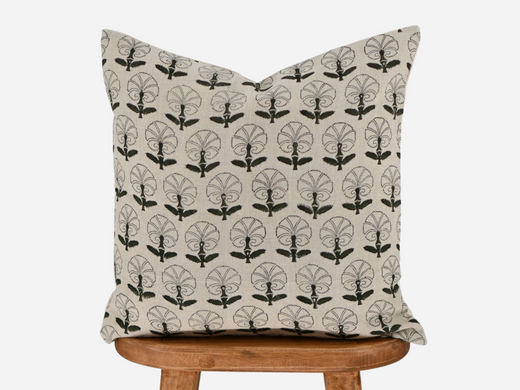
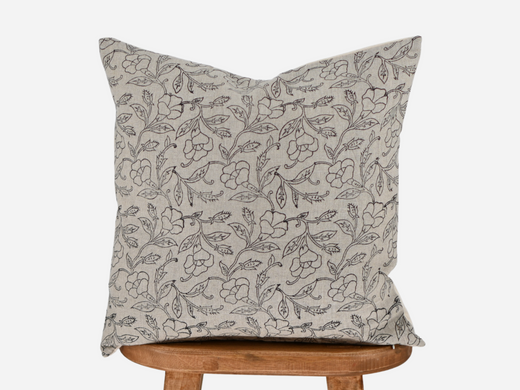
Block Print
Handcrafted pattern and visual movement
Solid Block Print
Subtle hand-printed texture in one colour
Plain Solid
Clean colour and calm surface
Ruffle
Soft, decorative edge detail
Solid Ruffle
Colour-blocked softness with edge detail
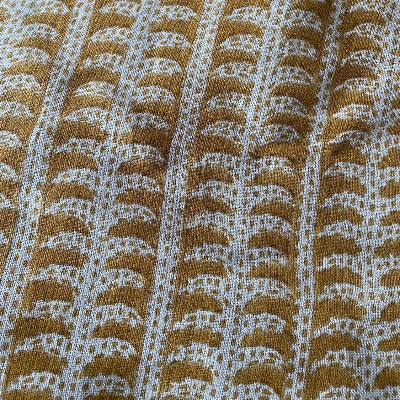
Handwoven
Textural, tactile and artisan-led
Bhujodi
Distinctive handwoven character and pattern
| Style | Character | Works especially well in | Styling direction |
|---|---|---|---|
| Block Print | Handcrafted pattern and visual movement | Eclectic, traditional and collected spaces | Pair with solids or quieter woven texture. |
| Solid Block Print | Subtle hand-printed texture in one colour | Layered rooms needing restraint | Use as a bridge between pattern and plain fabric. |
| Plain Solid | Clean colour and calm surface | Minimal, modern and pattern-rich rooms | Anchor printed or textured covers. |
| Ruffle | Soft, decorative edge detail | Romantic, cottage and relaxed bedrooms | Use selectively so the silhouette remains clear. |
| Solid Ruffle | Colour-blocked softness with edge detail | Gentle tonal arrangements | Mix with plain solids or one subtle print. |
| Handwoven | Textural, tactile and artisan-led | Natural, layered and crafted interiors | Let weave texture be the focal point. |
| Bhujodi | Distinctive handwoven character and pattern | Collected, heritage-led and earthy interiors | Use as a statement among simpler companions. |

Ruffle guidance
Ruffles add softness and a more decorative outline. They work best when the rest of the arrangement has enough plain surface to let the edge detail read clearly.
Handwoven and Bhujodi guidance
Handwoven and Bhujodi pillow covers bring texture, character and a visible artisan quality. Use them as the focal point in an arrangement, then support them with quieter solids or complementary patterns.

Single-sided vs double-sided guidance
Single-sided pillow covers are useful when the pillow will generally face one direction, such as against a sofa back or wall. Double-sided covers offer more flexibility when pillows move, flip or are used on open seating.
How Do You Choose Pillow Cover Colors?
Choose pillow cover colours by looking at the room as a whole. Pull one or two colours already present in the rug, artwork, curtains, bedding or upholstery. Include a light tone, a medium tone and a deeper accent if you want a layered result.
cream
soft brown
indigo details
woven texture
| Room colour direction | Pillow cover idea | Helpful balance |
|---|---|---|
| Warm neutrals | Cream, rust, ochre, soft brown and indigo details | Mix solids with one patterned cover. |
| Cool neutrals | Stone, grey-blue, muted indigo and soft white | Add warmth through woven texture. |
| Earthy room | Terracotta, olive, clay, mustard and natural linen tones | Use a dark accent for definition. |
| Colourful room | Pick two recurring colours from the room | Keep one pillow neutral to create pause. |
| Monochrome room | Use tonal shades in the same family | Vary fabric texture and pattern scale. |
Patterned rug or curtain guidance
If your rug or curtains are patterned, choose pillow covers that repeat one or two colours from the pattern rather than introducing many unrelated colours. A solid cover can give the eye a resting place; a smaller-scale pattern can complement a larger-scale rug or curtain motif.
How Do You Mix Pillow Patterns?
1 large-scale pattern + 1 small-scale pattern + 1 solid or texture = balanced arrangement
Mix patterns by varying scale, not by making everything equally busy. Use one larger-scale pattern, one smaller-scale pattern, and one solid or textured cover to create balance.
- Repeat at least one colour across the group.
- Pair geometric patterns with floral or organic motifs for contrast.
- Use a solid or solid block print between stronger patterns.
- Let one pillow be the focal point rather than asking every cover to compete.
- Use texture—such as handwoven fabric—as a quieter alternative to another print.

Common Pillow Cover Sizing Mistakes
Choosing a cover size without measuring the insert.
Measuring fabric edge to edge instead of seam to seam.
Using an insert that is too small for the look you want.
Using an insert that is so large that seams strain or the cover becomes difficult to close.
Using pillows that are too small for a deep sofa or wide bed.
Using oversized pillows on a compact chair.
Using too many identical sizes when the furniture needs layered depth.
Using too many different sizes without a clear scale hierarchy.
Ignoring pillow fill type and firmness when selecting an insert size.
Choosing colour and pattern without considering the room’s existing textiles.
Choose a pillow cover based on your insert size, furniture scale and the look you want. Use the same-size insert for a softer result or an insert 1–2 inches larger for a fuller look.
It can be. A same-size insert creates a softer, more relaxed appearance. An insert 1–2 inches larger can create a fuller, plumper appearance.
Lay the empty cover flat and measure seam to seam across both width and height. Use the finished seam measurement as the pillow cover size.
18 × 18 and 20 × 20 are versatile decorative sizes for many sofas, chairs and bed arrangements.
18 × 18 and 20 × 20 are useful starting points for a standard sofa. Move to 22 × 22 or 24 × 24 for a large or deep sofa, and use smaller sizes for loveseats and compact seating.
20 × 20 or 22 × 22 squares work well on many queen beds. A 12 × 24 or 12 × 30 lumbar can provide a centred finishing layer.
22 × 22 or 24 × 24 squares are useful on a king bed because they have enough scale. A 14 × 36 lumbar can create a long, centred focal line.
No. Matching sizes can look calm and symmetrical, while mixed sizes create layered depth. Use a clear size hierarchy so the arrangement still feels intentional.
A lumbar pillow cover is rectangular rather than square. It can add lower-back support on a chair and a horizontal accent on a sofa, bench or bed.
Multiply each inch measurement by 2.54. For example, a 20 × 20 inch pillow cover is approximately 51 × 51 centimetres.
